

American Book Publisherz built this guide for writers ready to take control of their own book’s future. Learning how to publish a book independently means learning a whole set of small skills that add up to one finished, professional product.
This blog guide walks through every stage, from choosing a format to tracking sales after launch, so you feel prepared for each decision ahead.
Choose Your Publishing Approach Print eBook or Both
Your first big decision shapes everything that follows, so take time to think through print, eBook, or both formats together.
Print books feel real in a reader’s hands and work well for signings, gifts, and local bookstore shelves. eBooks reach readers instantly worldwide and cost far less to produce, since there is no printing or shipping involved.
Many authors who study how to publish a book independently choose both formats from the start, since each one reaches a different type of reader.
Someone browsing on a phone during a commute wants an eBook, while someone attending your local launch event wants to hold a physical copy.
Consider your genre too, since cookbooks and picture books often sell better in print, while thrillers and romance often sell heavily as eBooks.
Think about your budget as well. Print runs require upfront costs for proofs and shipping, while eBooks need only formatting and a cover file.
Weigh your audience, your genre, and your available budget together before locking in your final approach, since this choice affects every step that follows in your publishing plan.
Prepare Your Manuscript Formatting and File Requirements
Every publishing platform expects your file to follow specific formatting rules, and skipping this step causes rejected uploads and frustrated authors.
Print books typically need a formatted PDF with exact trim size, margins, and bleed settings matched to your chosen page dimensions. eBooks need a clean EPUB or MOBI file built with proper heading tags so text reflows correctly across different screen sizes.
Authors learning how to publish a book independently often underestimate how much formatting differs between a Word document and a publish ready file.
Front matter like your title page, copyright page, and table of contents needs consistent styling that matches your book’s overall design. Chapter breaks, page numbers, and font choices all need attention before you upload anything to a distribution platform.
Consider using dedicated formatting software or hiring a formatter if this technical work feels overwhelming. A properly formatted manuscript looks professional and avoids embarrassing errors like broken page breaks or missing page numbers.
Test your file on multiple devices and print a physical proof copy before finalizing anything, since small formatting mistakes become obvious once you see the finished product in your hands.
Cover Design and Branding That Fits Your Genre and Audience
Readers judge books by their covers within seconds, making this one of the most important investments in your entire publishing budget.
Study bestselling covers in your genre and notice recurring patterns in color, typography, and imagery, since readers subconsciously expect certain visual cues from romance, thriller, or fantasy covers. A cover that looks out of place in its genre confuses potential buyers browsing online.
Authors focused on how to publish a book independently should budget for professional cover design rather than relying on free templates alone. A skilled designer understands how thumbnail sized covers appear on online store pages and makes sure your title stays readable even at a small size on a phone screen.
Font choice, color contrast, and image quality all affect whether a browsing reader stops to click on your book.
Branding extends beyond the cover itself into your author name styling, series formatting, and back cover copy. Keep these elements consistent across every book you publish, building recognition among readers who enjoy your work.
Strong branding turns a single sale into a returning reader who watches for your next release and recommends your books to friends.
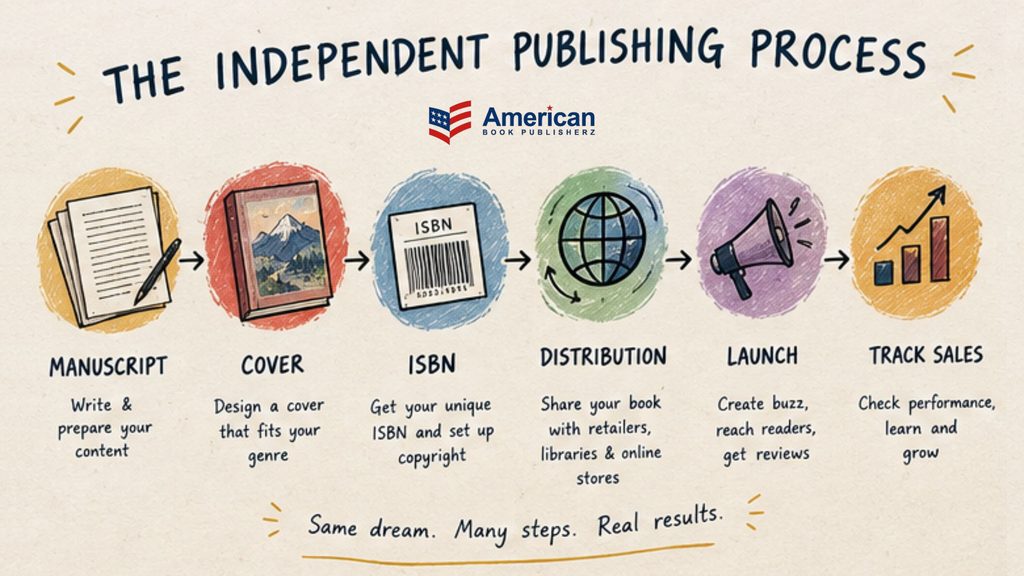
ISBN and Copyright Setup for Independent Authors
An ISBN acts as your book’s unique fingerprint, letting bookstores, libraries, and distributors track and order your title correctly. Independent authors can purchase their own ISBNs through official agencies or use free ISBNs offered by certain platforms, though free options often tie ownership to that specific platform.
Buying your own ISBN gives you full control over where and how your book appears.
Copyright protection exists automatically the moment you finish writing your manuscript, but registering it officially strengthens your legal position if anyone ever copies your work.
Authors researching how to publish a book independently should register their copyright through their country’s official copyright office, keeping proof of the registration date and original manuscript filed safely.
Consider whether you need separate ISBNs for print, eBook, and audiobook versions, since each format typically requires its own unique number.
Keep detailed records of every ISBN you purchase and which format it applies to, since distributors and retailers will ask for this information repeatedly throughout your publishing journey and any future editions you release.
Distribution Channels KDP IngramSpark and Direct Sales Options
Choosing where to sell your book determines how many readers can actually find and buy it. Amazon KDP remains the most popular starting point for independent authors, offering both print on demand and eBook distribution through the world’s largest online bookstore.
IngramSpark reaches a wider network of bookstores and libraries, though it charges setup fees that KDP does not.
Authors exploring how to publish a book independently often use multiple platforms together to maximize their reach across different reader habits.
Direct sales through your own website let you keep a larger share of each sale and build a direct relationship with your readers, though this option requires you to handle shipping and payment processing yourself.
Compare royalty rates, printing costs, and reach carefully before committing to one platform exclusively. Some authors start with KDP alone to test their book’s market response, then expand to IngramSpark once they confirm steady sales.
Research each platform’s specific requirements for file formats and cover dimensions, since these details vary and affect your overall publishing timeline.
Pricing Strategy Royalties and Getting the Most from Each Sale
Setting the right price balances reader expectations against your own profit goals, and getting this wrong can quietly sink an otherwise strong book launch.
Research what similar books in your genre charge for both print and eBook formats, since pricing far above or below that range confuses potential buyers browsing a crowded category page.
Authors learning how to publish a book independently need to understand how royalties actually work on each platform. KDP typically offers a higher royalty percentage within a specific price range, while pricing outside that range drops your earnings per sale significantly.
Print books carry manufacturing costs that eat into your royalty, so calculate your actual profit per copy before settling on a final price.
Consider running limited time discounts or bundle deals to boost visibility during your launch window, since many platforms reward recently active listings with better placement.
Track how price changes affect your daily sales numbers, adjusting gradually rather than guessing. A well researched price point earns steady sales over months rather than a single quick spike that fades away.
Build Your Launch Plan Marketing Preorders and Distribution Readiness
A strong launch depends on preparation that starts months before your actual release date, not scrambling the week your book goes live.
Set up a preorder listing as early as your chosen platform allows, since preorders build early momentum and often count toward first week sales rankings that boost visibility once your book officially releases.
Authors serious about how to publish a book independently build an email list and social media presence well before launch day arrives. Reach out to book reviewers, bloggers, and podcast hosts in your genre months in advance, since many reviewers need significant lead time before your release.
Prepare promotional graphics, sample chapters, and a clear author bio ready to share across every platform you use.
Confirm your distribution readiness by ordering author copies early and checking that every retail link works correctly before announcing your launch publicly.
Plan a specific launch week schedule covering social posts, newsletter emails, and any planned promotions or price drops. A well organized launch plan turns a quiet release into a book that gains real visibility from its very first day.
Set Up Author Profiles Metadata and Category Optimization
Your author profile and book metadata work quietly behind the scenes, helping readers discover your book through search and browsing on every platform.
Complete your author profile fully on each distribution site, adding a clear bio, professional photo, and links to your other books or website, since a complete profile builds trust with browsing readers.
Metadata includes your book description, keywords, and category selections, all of which directly affect how easily readers find your book.
Authors focused on how to publish a book independently should research which specific keywords their target readers actually search for, then work those terms naturally into their book description and backend keyword fields.
Category selection matters just as much as keywords, since ranking well in a smaller, specific category often beats ranking poorly in a broad, crowded one. Study which categories your genre’s bestsellers occupy, then choose categories that fit your book honestly while still offering realistic ranking potential.
Revisit your metadata periodically, since small adjustments can meaningfully improve your book’s discoverability over time.
Track Performance Metrics and Improve with Iteration After Launch
Publishing your book marks the beginning of an ongoing process, not a finish line you cross and forget. Check your sales dashboard regularly across every platform, watching for patterns in which formats, price points, or promotional periods perform best.
Reviews and reader feedback offer valuable clues about what worked well and what might need adjustment in future editions or future books.
Authors who study how to publish a book independently over time treat their first release as a learning experience rather than a single final product.
Test different cover versions, description wording, or price points gradually, measuring each change against your baseline sales numbers before making permanent decisions. Small, deliberate adjustments often produce better long term results than dramatic changes made all at once.
Use what you learn from your first book to strengthen your next release, applying lessons about formatting, marketing timing, and reader response.
American Book Publisherz encourages every independent author to view each published book as practice for the next one, building skills and confidence that compound with every project you complete.
Ready To Publish Your Book on Your Own Terms?
Contact American Book Publisherz today for expert editing, cover design, formatting, and guidance.
Concluding statement
Self-publishing rewards authors willing to learn each step carefully. American Book Publisherz encourages you to treat formatting, design, and marketing as connected pieces of one plan.
Mastering how to publish a book independently takes patience, but the control and rewards make every effort worthwhile for your writing career.
Frequently Asked Questions
You format your manuscript, design a cover, choose a platform, and upload your files yourself. Learning how to publish a book independently means handling each step personally, giving you full creative control over your finished book.
Independent publishing means you handle every stage yourself instead of working through a traditional publishing house. You control your cover, pricing, and distribution, learning how to publish a book independently while keeping full ownership of your work.
Costs vary widely based on editing, cover design, and formatting choices, often ranging from a few hundred to several thousand dollars. How to publish a book independently affordably starts with prioritizing editing and cover quality first.
Yes, an ISBN helps bookstores and distributors track your book properly. You can buy your own or use a free one from certain platforms. Understanding how to publish a book independently means knowing which ISBN option fits your goals.
Amazon KDP, IngramSpark, and direct sales through your own website all work well. Each platform offers different reach and royalty rates, so compare them carefully when learning how to publish a book independently.
Yes, professional editing catches errors and weak spots you cannot see in your own writing. Anyone researching how to publish a book independently should budget for editing before uploading any final files anywhere.
Build an email list, reach out to reviewers, and use social media consistently before and after launch. Marketing remains essential to how to publish a book independently successfully and keep readers discovering your work.
Yes, independent authors handle every step themselves and keep full creative control and higher royalty percentages. Millions of writers now choose how to publish a book independently instead of pursuing traditional publishing deals.